Ramps, doors, extensions, heating and more
Disabled Facilities Grant: get a home adaptation quote and find your council
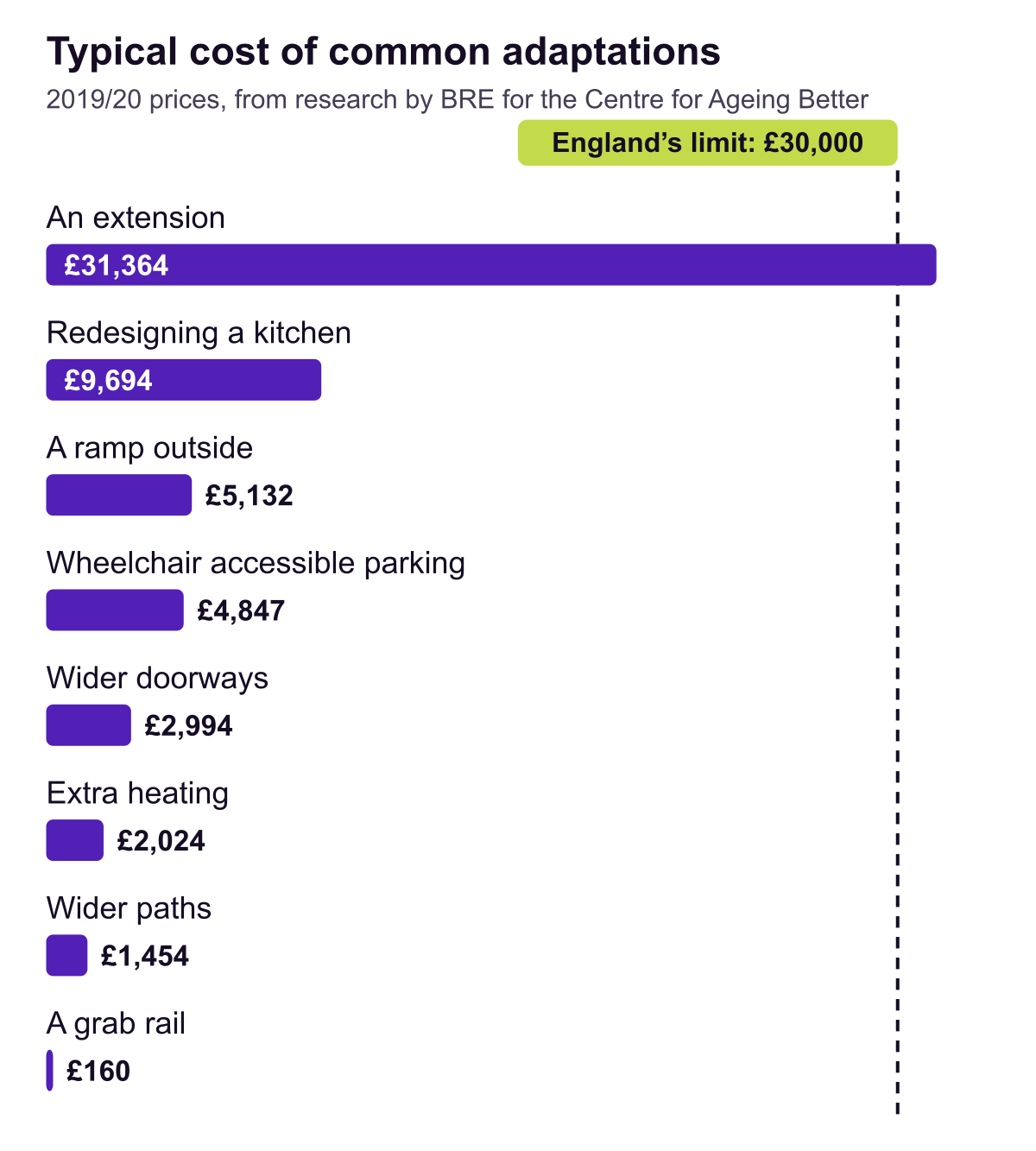
The Disabled Facilities Grant is money from the council towards changing a disabled person’s home: wider doors and ramps, a downstairs bedroom, heating that suits them, a safe way into the garden (GOV.UK, checked 12 November 2026). In England a grant can be up to £30,000, and some councils may give more (GOV.UK, checked 12 November 2026). Ask us for a quote for the work, and find your own council and its grant money for this year.
Data last reviewed: 13 November 2026. Each figure here names its source and the day we read it.
Before you ask the council
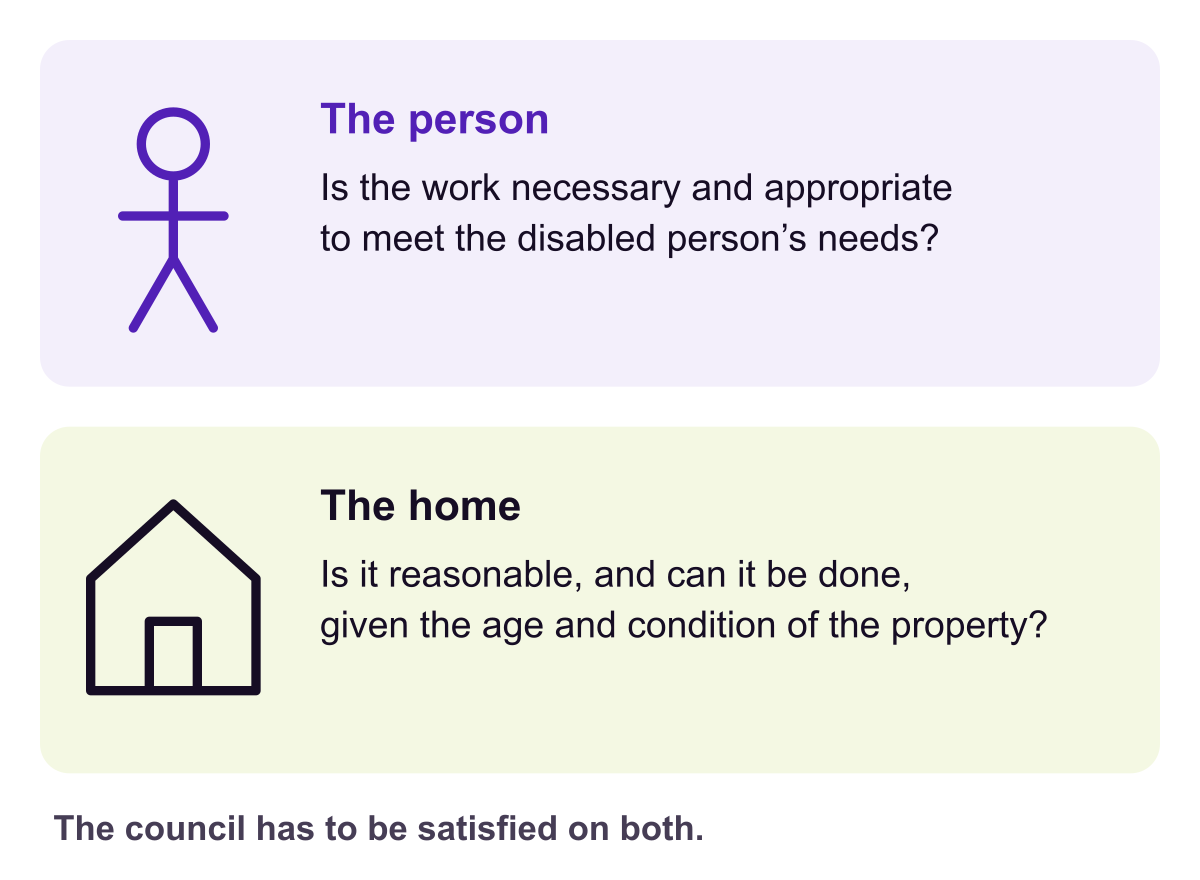
- The council judges the needThe work has to be necessary and appropriate for the disabled person, and reasonable and possible in that house (GOV.UK, checked 12 November 2026).
- Income can count in EnglandWhat you get usually depends on income and on savings above £6,000 (GOV.UK, checked 12 November 2026).
- Allow months, not weeksA decision is due within 6 months, and the work should be done within 12 months of approval (GOV.UK, checked 13 November 2026).
- Each nation differsWales, Scotland and Northern Ireland have their own limits and their own first step, set out below.
Wait for approval before any work starts. Starting first can mean no grant at all (GOV.UK, checked 12 November 2026). Getting a quote does not count as starting.
The grant in four figures
What the money looks like this year
- £723 million for the grant in England in 2026-27
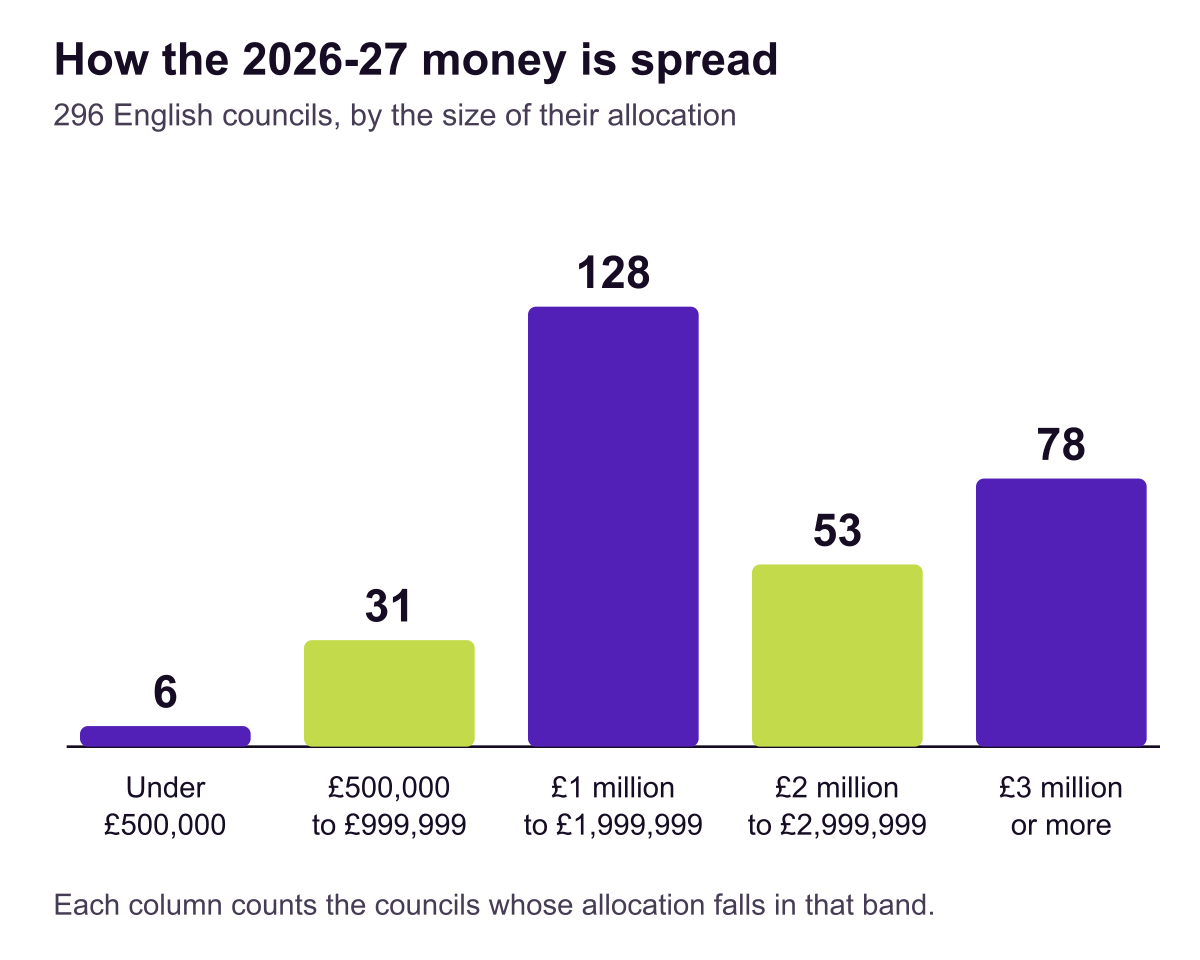
England’s total for 2026-27, shared between 296 councils (GOV.UK, checked 12 November 2026)
- £30,000 most for one grant in England
The most one grant can be in England, unless the council’s own policy adds more (GOV.UK, checked 12 November 2026)
- £36,000 most for one grant in Wales
The Welsh limit, set by its own order (legislation.gov.uk, checked 12 November 2026)
- £35,000 Housing Executive limit in Northern Ireland
Northern Ireland’s limit on a low income, and £70,000 in some cases (nidirect, checked 13 November 2026)
Room by room
What the grant can change in a home
GOV.UK’s own list runs from the front door to the back garden: widening doors, ramps and grab rails, getting into rooms and to the facilities in them, access to the garden, an extension such as a downstairs bedroom, a heating system suited to the person, and heating or lighting controls they can use (GOV.UK, checked 12 November 2026). Pick a part of the house to see what it involves.
Where the grant can reach in a home
- 1A ramp or a level way inSteps at the door replaced by a slope or a level path
- 2Wider doors and passagesRoom for a wheelchair or a frame to pass
- 3The stairsGetting between floors, one of the grant’s purposes
- 4The bathroomWashing and the toilet, also among its purposes
- 5A downstairs bedroom or extensionWhen a council looks at building on
- 6Heating and easier controlsWarmth suited to the person, controls they can use
- 7The kitchenWhat a council may change so it can be used
- 8Getting into the gardenA safe way out and back
- 9Parking near the doorDriveways, paths and dropped kerbs
Most grant-funded jobs are not big building projects. The government’s 2018 review found that 57% of the work in 2015/16 cost less than £5,000 (2018 government review, checked 13 November 2026). The larger jobs, such as building on, are explained on extensions and extra bedrooms; the full list, with what each item means in practice, is on what the grant pays for; and the smaller changes outside the grant are on minor adaptations.
Where you live
The grant in each of the four nations
The name, the limit and the place to start all change at the border. Choose your nation.
England
Up to £30,000
You ask your local council, and some councils may give more than the limit (GOV.UK, checked 12 November 2026). GOV.UK’s local service takes a postcode and finds the right council for you (GOV.UK, checked 13 November 2026). Each council’s share of this year’s money is in the council finder. The rest is on the grant in England.
Wales
Up to £36,000
The Welsh order sets a higher ceiling than England’s (legislation.gov.uk, checked 12 November 2026), and most Welsh councils no longer means-test small and medium grants (Welsh Government, checked 12 November 2026). Wales also funds quicker routes for small jobs (Welsh Government, checked 12 November 2026). See the grant in Wales.
Scotland
At least 80% of the cost
There is no Disabled Facilities Grant in Scotland. Where the council decides an adaptation is essential and the work is structural or permanent, it must pay at least 80% of the approved cost, and all of it for people on certain benefits (legislation.gov.uk, checked 12 November 2026). See help with adaptations in Scotland.
Northern Ireland
Up to £35,000
The Housing Executive, not the council, gives the grant here: up to £35,000 on a low income, rising to £70,000 in some cases (nidirect, checked 13 November 2026). It is a means tested grant (Department for Communities, checked 13 November 2026). See the grant in Northern Ireland.
Who it is for
Who can get the grant
GOV.UK describes the grant as being for a disabled person who needs changes to their home, and gives a wide set of examples: a physical disability, a learning disability, age-related needs, autism, a cognitive impairment such as dementia, a progressive condition, a terminal illness or a mental health condition (GOV.UK, checked 13 November 2026). Age alone is not the test; the need is.
The application can come from the owner, a tenant or a landlord, and the disabled person has to mean to live in the home for the grant period, normally 5 years (GOV.UK, checked 12 November 2026). Then two judgements decide it. Is the work necessary and appropriate for that person? And is it reasonable, and possible, given the age and condition of the building (GOV.UK, checked 12 November 2026)? Families who know the first answer often trip over the second, so who qualifies takes both in turn, with the cases that tend to cause doubt. Renting brings its own questions about consent, covered on tenants and landlords, and a child’s grant is worked out differently, as disabled children explains.
How much
The most one grant can be, nation by nation
| Nation | Who gives it | The most it pays | Source |
|---|---|---|---|
| England | Your council | £30,000 | (GOV.UK, checked 12 November 2026) |
| Wales | Your council | £36,000 | (legislation.gov.uk, checked 12 November 2026) |
| Northern Ireland | The Housing Executive | £35,000 (£70,000 in some cases) | (nidirect, checked 13 November 2026) |
| Scotland | Your council (no grant of this name) | At least 80% of the approved cost | (legislation.gov.uk, checked 12 November 2026) |
England’s figure had been unchanged from 2008 when the government’s 2018 review looked at it (2018 government review, checked 13 November 2026), and in February 2026 the government said it had reviewed the upper limit and was still considering the right approach (consultation response, checked 13 November 2026). A council can go further through its own policy. How the figures interact with a contribution from the means test, and what happens when the work costs more than the limit, is worked through on how much the grant is.
Your council’s money
Every English council has its own share for 2026-27
The government shares England’s £723 million between 296 councils by a formula; the Department of Health and Social Care provides it (consultation response, checked 13 November 2026). The five largest shares this year, with the middle figure for comparison:
| Council | Tier | 2026-27 allocation |
|---|---|---|
| Birmingham | Single-tier | £16,636,797 |
| Liverpool | Single-tier | £10,944,132 |
| Manchester | Single-tier | £10,525,724 |
| Leeds | Single-tier | £10,281,651 |
| Cornwall | Single-tier | £9,366,480 |
| The middle council of all 296 | Median | £1,831,568 |
From Annex A of the government’s 17 February 2026 consultation response, read 13 November 2026. A council’s total is not what one person can get.
What comes with it
Conditions, repayment and other help
A grant comes with conditions. The usual grant period is 5 years from the date the council signs the work off, and if the plan really was for the disabled person to live there, nothing is repaid when circumstances change (government guidance to councils, checked 13 November 2026). On an owner’s home in England the council may register a local land charge where the grant is over £5,000; it can recover up to £10,000, and only after a sale or other disposal within 10 years (government guidance to councils, checked 13 November 2026). The detail, and the reasons a council must weigh before asking, are on repayment and conditions.
Two other kinds of help need no grant at all. In England a council must not charge for a minor adaptation of £1,000 or less that meets an adult’s assessed care needs (legislation.gov.uk, checked 12 November 2026). And building work for a disabled person’s own home, such as putting in ramps, widening doors and passages or installing a lift, carries no VAT (GOV.UK, checked 12 November 2026), which matters most when you pay yourself. See VAT on adaptations.
Who runs this site
A publisher, not the council
Home Adaptation Grants is published by SEO Dons Ltd. It is not a council, a government department, the NHS, a charity or a builder, and it cannot apply for a grant or say whether one will be given: only the council decides. What it does is set out the rules, the money and the sources in one place, and answer requests for a quote for the work itself.
If you fill in the form, your details come to SEO Dons Ltd and we reply by email; nothing commits you. How every fact here is checked is on sources and checks, the company behind the site is on about this site, and short answers to common questions are in questions.
Questions about the Disabled Facilities Grant
It is a grant from the council towards changing a home so that a disabled person can live there safely and get around it: ramps and wider doors, a downstairs bedroom, heating they can use, a way into the garden, and more. It exists in England, Wales and Northern Ireland. Scotland has no grant by that name; councils there help through a scheme of assistance instead.
Up to £30,000 in England, where some councils may give more, and up to £36,000 in Wales. In Northern Ireland the Housing Executive’s grant can be up to £35,000 for someone on a low income, and £70,000 in some cases. In Scotland the council pays at least 80% of the approved cost of essential work. A limit is the most a grant can be, not an amount anyone is promised.
Only in set circumstances. In England a council may register a charge on an owner’s home when the grant is more than £5,000, and can ask for up to £10,000 back only if the home is sold or otherwise disposed of within 10 years of the work being signed off. It must weigh hardship and the reasons for a move before it asks.
Yes, it can. GOV.UK names an extension, for example a downstairs bedroom, among the things the grant can pay for. The council has to agree that the work is necessary and appropriate and that it is reasonable and can be done in that house.
From the government. For 2026-27 England’s total is £723 million, provided by the Department of Health and Social Care and shared between councils by a formula. Every council’s share is on our allocations page.
Where this page’s facts come from
Each rule and figure on this page was read on one of the pages below, on the date shown. Data last reviewed: 13 November 2026. Seen a change at the source? Let us know and we will read it again.
- 13 November 2026: GOV.UK, Disabled Facilities Grants: overview
- 12 November 2026: GOV.UK, Disabled Facilities Grants: what you’ll get
- 12 November 2026: Disabled Facilities Grants (Maximum Amounts and Additional Purposes) (Wales) Order 2008 (legislation.gov.uk)
- 13 November 2026: nidirect, Disabled Facilities Grants
- 12 November 2026: Scheme of Assistance Regulations 2008 (SSI 2008/406), regulations 3 and 4, as amended in 2013 (legislation.gov.uk)
- 12 November 2026: Welsh Government, written statement on removing the means test for small and medium grants (gov.wales)
- 13 November 2026: GOV.UK, Disabled Facilities Grants: how to apply
- 12 November 2026: GOV.UK, Disabled Facilities Grants: eligibility
- 13 November 2026: GOV.UK, consultation response on Disabled Facilities Grant allocations (17 February 2026)
- 13 November 2026: Disabled Facilities Grant (DFG) and Other Adaptations: External Review, main report (for the government, December 2018)
- 13 November 2026: Disabled Facilities Grant (DFG) delivery: guidance for local authorities in England (gov.uk, 28 March 2022)
- 12 November 2026: Care and Support (Charging and Assessment of Resources) Regulations 2014, regulation 3 (legislation.gov.uk)
- 12 November 2026: GOV.UK, VAT relief for disabled people
- 13 November 2026: Department for Communities, The Disabled Facilities Grant (DFG) (communities-ni.gov.uk)
- 12 November 2026: Welsh Government, Adapt your home if you are disabled or an older person (gov.wales)
- 13 November 2026: GOV.UK, Apply for a Disabled Facilities Grant (local council service)
- 13 November 2026: BRE, National Evaluation of Home Improvement Services: BRE supporting research (Centre for Ageing Better, February 2025)
Price the changes your home needs
Tell us what needs doing and roughly when. If a grant is likely, keep the order on hold until the council approves it.