Grant for a disabled ramp: ramps, wider doors and paths at home
A grant for a disabled ramp at home can come through the council’s Disabled Facilities Grant: GOV.UK’s list of what it pays for starts with widening doors and installing ramps or grab rails (GOV.UK, checked 12 November 2026). In England a small ramp of £1,000 or less that meets assessed care needs can be free as a minor adaptation (legislation.gov.uk, checked 12 November 2026), and building work for ramps and wider doorways in a disabled person’s home carries no VAT (GOV.UK, checked 12 November 2026).
Data last reviewed: 13 November 2026. Every figure on this page names its source and the day we read it.
What to expect with a ramp
- The grant covers itGetting into and out of the home is one of the purposes in the law (1996 Act, section 23, checked 13 November 2026).
- Small can be freeIn England, a minor adaptation of £1,000 or less costs nothing (legislation.gov.uk, checked 12 November 2026).
- The ground sets the priceHilly places often need more complicated ramping (2018 government review, checked 13 November 2026).
- The need decides the designThe council judges what is necessary and appropriate, and possible in the house (GOV.UK, checked 12 November 2026).
Wait for approval before building. Work started first may get no grant (GOV.UK, checked 12 November 2026).
Get a home adaptation quote
Tell us what needs changing and the postcode of the home. Your details come to SEO Dons Ltd, the publisher of Home Adaptation Grants, and we reply by email. Asking commits you to nothing.
What happens next
- Your details reach SEO Dons Ltd, the company that publishes this site.
- We read which adaptation you are pricing and reply by email.
- A quote binds you to nothing. If you hope for a council grant, the council has to approve the work before it starts.
Ramps, doors and paths under the grant
The first purpose in the law is access to and from the home (1996 Act, section 23, checked 13 November 2026). The guidance reads it broadly: removing or helping overcome the obstacles that stop the disabled person moving freely in and out of the property, including common parts, the garden and any yard, outhouse or balcony (government guidance to councils, checked 13 November 2026). So a ramp to the front door, a wider doorway, a level path to the gate and a ramp to the back garden can all fall under it. In blocks of flats the grant can reach the shared paths and doors too (government guidance to councils, checked 13 November 2026).
Inside the home the same idea applies to getting to the main living room and to a bedroom, which is where widening internal doors comes in. The full list of purposes is on what the grant pays for, and the two tests every job must pass are on who qualifies.
What a usable ramp looks like
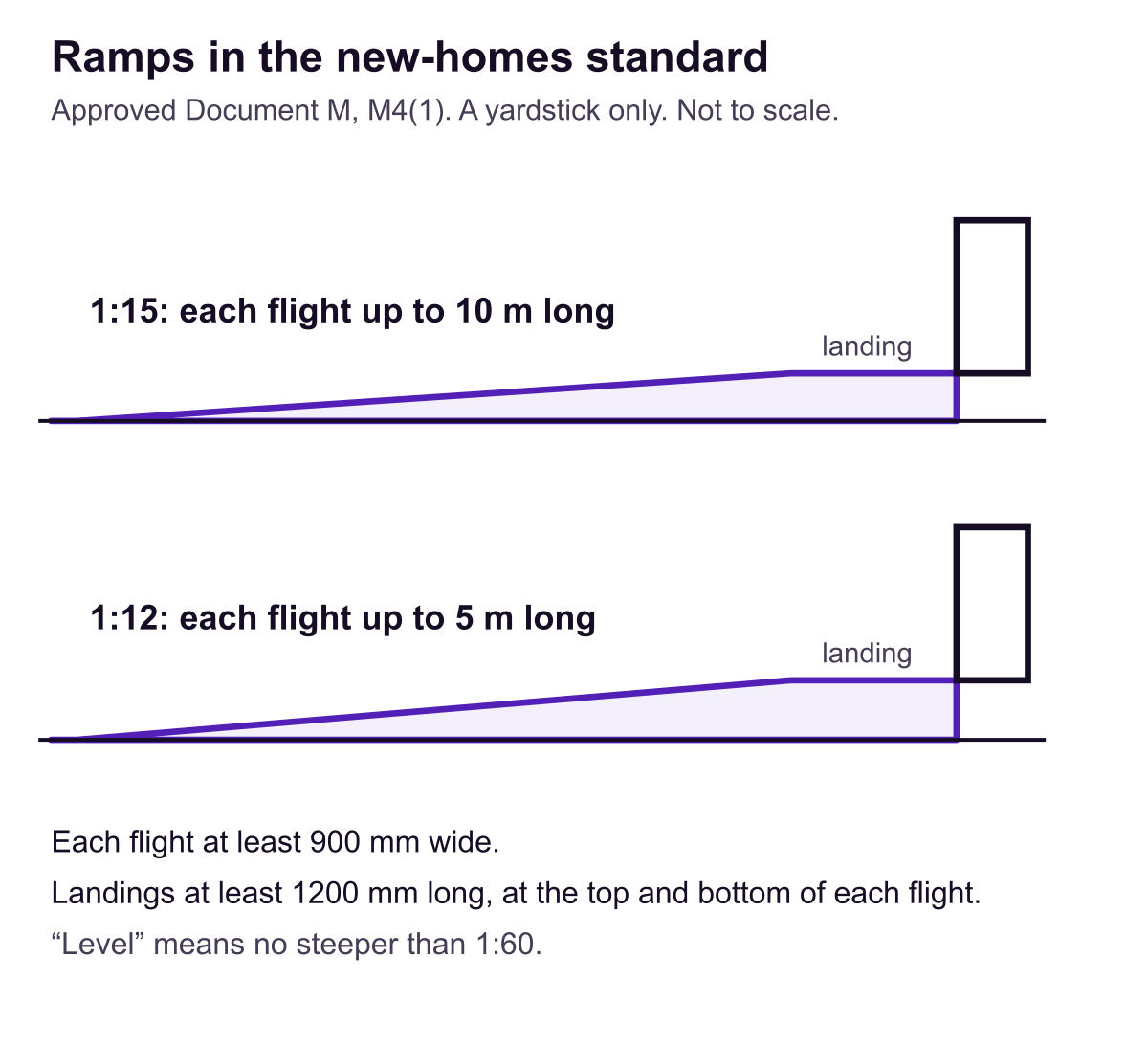
There is no special rulebook for grant-funded ramps, but the building regulations’ guidance on access, Approved Document M, sets out what is reasonable for new homes. It is not binding on adaptations: it applies to newly built homes and material alterations, not to extensions (Approved Document M, checked 13 November 2026), and approved documents describe what may be accepted in ordinary circumstances rather than the only way to comply (Approved Document M, checked 13 November 2026). As a yardstick, though, it is the clearest public standard there is:
| Standard | Gradient | Clear width | Source |
|---|---|---|---|
| Every new home, M4(1) | Up to 1:15 for flights up to 10m; up to 1:12 for flights up to 5m | 900mm | (Approved Document M, checked 13 November 2026) |
| Accessible and adaptable, M4(2) | Between 1:20 and 1:12 | 900mm private, 1200mm shared | (Approved Document M, checked 13 November 2026) |
| Wheelchair user, M4(3) | Between 1:20 and 1:15 | 1200mm | (Approved Document M, checked 13 November 2026) |
The same document calls a slope “level” up to 1:60, and a “ramp” between 1:20 and 1:12 (Approved Document M, checked 13 November 2026). Every flight needs landings at the top and bottom, at least 1200mm long and clear of any door swing (Approved Document M, checked 13 November 2026).
In plain terms: the gentler the slope, the longer the ramp, and a short run of steps can turn into a long ramp with a landing or two. That is why a ramp can need more space than it first appears, and why the ground around the house drives the cost.
Doors and thresholds
The same guidance sets a minimum clear opening width of 775mm for the main entrance door of every new home (Approved Document M, checked 13 November 2026), and 850mm for the entrance and other outside doors, garden doors included, in an accessible and adaptable home (Approved Document M, checked 13 November 2026). An accessible threshold is level, or no more than 15mm high in total (Approved Document M, checked 13 November 2026). Clear width is measured from the door stop to the face of the door opened to 90 degrees, so it is always less than the width of the door itself.
What ramps and doors cost
| Work | Figure | What it is | Source |
|---|---|---|---|
| A ramp, England | £3,928 | Average grant-funded ramp, 2016/17; regions £2,769 to £5,327 | (2018 government review, checked 13 November 2026) |
| An outside ramp | £5,132 | Typical cost, 2019/20 prices | (BRE for the Centre for Ageing Better, checked 13 November 2026) |
| An inside ramp | £576 | Typical cost, 2019/20 prices | (BRE for the Centre for Ageing Better, checked 13 November 2026) |
| Wider doorways | £2,994 | Typical cost, 2019/20 prices | (BRE for the Centre for Ageing Better, checked 13 November 2026) |
| Wider paths | £1,454 | Typical cost, 2019/20 prices | (BRE for the Centre for Ageing Better, checked 13 November 2026) |
Older figures, a sense of scale rather than a price for your home.
The government’s 2018 review noted that ramps vary more in price than other adaptations, partly because places with hills often need more complicated ramping systems (2018 government review, checked 13 November 2026). All of these figures sit well inside England’s £30,000 limit, so for a job this size it is the means test, not the limit, that sets how much of the cost the grant meets; see how much the grant is.
Small ramps outside the grant
Not every ramp needs a grant application. In England a council must not charge for minor adaptations of £1,000 or less that it provides to meet an adult’s assessed care needs (legislation.gov.uk, checked 12 November 2026), and the typical inside ramp in the table sits under that line. Wales counts small ramps as small adaptations and large ramps as medium ones, and in 2023/24 and 2024/25 no Welsh council means-tested small adaptations (Welsh Government, checked 12 November 2026). See minor adaptations.
VAT on ramps and doorways
For a disabled person’s own home, building work to put in ramps and widen existing doorways and passages carries no VAT (GOV.UK, checked 12 November 2026). Someone aged 60 or over who is not disabled pays 5% on a ramp when the same firm supplies and installs it (HMRC Notice 701/7, checked 12 November 2026). More on VAT on adaptations.
Rented homes, and other buildings
In a rented home the landlord’s permission is normally needed, but under the Equality Act 2010 a landlord cannot unreasonably withhold consent to an adaptation (government guidance to councils, checked 13 November 2026), and a council can approve a grant for work inside the home where consent has been unreasonably withheld (government guidance to councils, checked 13 November 2026). The rules, and their exceptions, are on tenants and landlords. Access to shops, churches and other buildings that are not homes is a different subject: this grant is for the home. To ask about a ramp where you live, start with the council finder.
Questions about ramps and access
Yes. Widening doors and installing ramps are the first examples GOV.UK gives of what a Disabled Facilities Grant can pay for. In England a small ramp costing £1,000 or less that meets assessed care needs can come free from the council as a minor adaptation instead.
For new homes, the building regulations’ guidance treats a gradient between 1:20 and 1:12 as a ramp, and at 1:12 a flight should be no longer than 5m. Those rules are written for new homes, not for adaptations, but they are the clearest public yardstick.
Not if it is for a disabled person’s own home: building work to put in ramps and widen doorways is zero-rated. Someone aged 60 or over who is not disabled pays 5% on a ramp supplied and fitted by the same firm.
A landlord cannot unreasonably withhold consent to an adaptation under the Equality Act 2010, and a council can approve a grant for work inside the home where consent has been unreasonably withheld. Our tenants and landlords page has the detail and the exceptions.
Where this page’s facts come from
Each rule and figure on this page was read on one of the pages below, on the date shown. Data last reviewed: 13 November 2026. Seen a change at the source? Let us know and we will read it again.
- 12 November 2026: GOV.UK, Disabled Facilities Grants: overview
- 13 November 2026: legislation.gov.uk, Housing Grants, Construction and Regeneration Act 1996 (c. 53), section 23
- 13 November 2026: GOV.UK (MHCLG and DHSC), Disabled Facilities Grant (DFG) delivery: Guidance for local authorities in England (published 28 March 2022)
- 12 November 2026: Care and Support (Charging and Assessment of Resources) Regulations 2014, regulation 3 (legislation.gov.uk)
- 12 November 2026: GOV.UK, VAT relief for disabled people
- 12 November 2026: HMRC, Reliefs from VAT for disabled and older people (VAT Notice 701/7)
- 13 November 2026: Disabled Facilities Grant (DFG) and Other Adaptations: External Review, main report (for the government, December 2018)
- 13 November 2026: BRE, National Evaluation of Home Improvement Services: BRE supporting research (Centre for Ageing Better, February 2025)
- 13 November 2026: HM Government, Approved Document M: Access to and use of buildings, Volume 1: Dwellings, 2015 edition incorporating 2016 amendments (England)
- 12 November 2026: Welsh Government, ENABLE: support for living independently (gov.wales)
- 12 November 2026: GOV.UK, Disabled Facilities Grants: eligibility